
Last updated June 22, 2026
The Complete Guide to Garage Door in Miami
A galvanized torsion spring rated for 10,000 cycles can fail in under three years in coastal Miami — not because it’s defective, but because the spec was written for landlocked climates. Salt air corrosion is the silent killer most garage door guides never mention, and it’s responsible for a significant share of the premature failures we diagnose every week across neighborhoods from Brickell to Hialeah. Most “complete guides” online were written for generic American homeowners in dry or temperate climates. This one wasn’t. Every recommendation here is filtered through what actually holds up in South Florida’s heat, humidity, hurricane season, and salt-air environment — because what works in Ohio will fail you in Miami.
Quick Answer
A garage door in Miami must meet Miami-Dade County’s Florida Product Approval (NOA) wind-load requirements under Florida Building Code Chapter 16 — this is non-negotiable and overrides any national brand spec. The right door for this market is built from corrosion-resistant materials (heavy-gauge steel, aluminum, or fiberglass), maintained on a climate-adjusted schedule twice a year, and serviced by someone who understands that standard hardware lifespans shrink significantly in coastal conditions. Everything else in this guide is the detail behind that summary.
Table of Contents
- Why Miami-Dade NOA Ratings Matter More Than Brand Names
- Material Comparison for Coastal Conditions: Steel, Aluminum, and Fiberglass
- Florida Building Code Chapter 16 and Wind Load Requirements
- Spring and Hardware Lifespan in Miami’s Climate
- The Miami Maintenance Schedule: Wet Season, Dry Season
- Choosing the Right Garage Door Opener for South Florida
- What to Expect During Garage Door Installation in Miami
- Common Mistakes to Avoid
- When to Call a Professional
- Frequently Asked Questions
- The Bottom Line
Why Miami-Dade NOA Ratings Matter More Than Brand Names
When Miami homeowners shop for a new garage door, the first question is usually “which brand?” That’s the wrong starting point. The first question should be: “Does this door carry a Miami-Dade Notice of Acceptance (NOA)?”
An NOA is a product approval issued by Miami-Dade County’s Building Department confirming that a specific door model has been independently tested and verified to meet South Florida’s extreme wind-load standards. Without a valid NOA, a door cannot be legally permitted and installed in Miami-Dade County — full stop, regardless of how reputable the brand is nationally.
Here’s why this matters practically: two doors from the same manufacturer, even the same product line, can have completely different wind ratings depending on their construction. A Clopay steel door in one panel thickness may carry an NOA for 130 mph wind loads; a thinner version of the same aesthetic line may not qualify at all. The same distinction applies to Amarr, Wayne Dalton, and every other brand on the market.
When you’re evaluating doors, ask your installer for the NOA number — every approved product has one — and verify it through the Miami-Dade County Product Approval search tool. A contractor who can’t immediately produce this information is a contractor who hasn’t done this work in Miami long enough to know the basics.
- NOA applies to the specific model and size: A door that clears NOA at 8×7 feet may not hold the same rating at 16×7 feet — wider spans require additional wind bracing.
- Impact-rated vs. wind-load-rated: Some doors are rated for windborne debris (impact); others meet wind pressure requirements but not impact. Know which your insurance requires.
- Re-permitting after hurricane damage: If you replace a storm-damaged door, you cannot substitute a non-NOA product even temporarily. The replacement must meet current code.
Material Comparison for Coastal Conditions: Steel, Aluminum, and Fiberglass
Material selection for a Miami garage door isn’t about aesthetics first — it’s about which materials can tolerate years of salt-laden air, afternoon thunderstorms, and temperatures that rarely drop below 60°F even in January. Here’s how the three primary materials compare in this specific environment.
Steel
Steel is the most common material and, when specified correctly, performs well in Miami. The key variable is gauge: 24-gauge steel is the minimum we’d recommend for coastal South Florida; 25-gauge (which sounds like a bigger number but is actually thinner) degrades faster under constant humidity and salt exposure. Look for doors with a galvanized steel skin and a factory-applied primer plus paint finish — bare or poorly coated steel will show surface rust within two to three years in neighborhoods close to Biscayne Bay or the Atlantic coast. Brands like Clopay and Amarr offer polyurethane-insulated steel panels that add moisture resistance from the inside out, which meaningfully extends the panel’s service life in humid conditions.
Aluminum
Aluminum doesn’t rust — full stop. For homes within a mile of the ocean in areas like Miami Beach, Key Biscayne, or Surfside, aluminum is often the right call despite its higher upfront cost. It’s lighter than steel, which reduces wear on springs and opener motors over time. The trade-off is that aluminum dents more easily than heavy-gauge steel, so it’s not ideal for households with active driveways. Look for anodized or powder-coated finishes to maximize corrosion resistance.
Fiberglass
Fiberglass is the most salt-air-resistant material available and is a genuine option for extreme coastal exposures. It’s also the most expensive and, historically, harder to source locally with full NOA compliance. We see fiberglass more often in high-end waterfront properties where the priority is longevity and low maintenance over a 20-year horizon.
Material Comparison at a Glance
- 24-gauge galvanized steel: Best value for most Miami neighborhoods; needs quality finish to resist corrosion
- Aluminum: Best for oceanfront or bay-front homes; rust-proof, lightweight, higher cost
- Fiberglass: Maximum salt-air longevity; premium pricing; verify NOA availability before committing
- Wood and wood-composite: Not recommended for high-humidity Miami conditions — wood absorbs moisture, swells, and warps faster here than virtually anywhere else in the country
Florida Building Code Chapter 16 and Wind Load Requirements
Florida Building Code Chapter 16 governs structural loads on buildings, and its wind-load provisions are among the strictest in the United States — for good reason. Miami-Dade County sits in a High-Velocity Hurricane Zone (HVHZ), a designation that requires garage doors to withstand design wind speeds of 175 mph or higher in many residential areas.
What this means in practice:
- Every garage door installation requires a permit in Miami-Dade County. This is not optional and not a formality — it’s how the county verifies that the product and installation meet HVHZ standards. Any contractor who suggests skipping the permit to save time or money is exposing you to a failed inspection, fines, and potentially voided homeowners insurance coverage.
- The door must match the opening’s wind-load design pressure. Your home’s structural drawings specify the design pressure (DP) rating required for each garage opening. The door you install must meet or exceed that DP rating. A common mistake is purchasing a door that clears NOA at a lower DP than the opening requires.
- Wind bracing and horizontal track upgrades may be required. For larger openings — particularly two-car doors wider than 16 feet — additional horizontal track reinforcement or vertical support columns may be required to achieve the necessary rigidity under wind load.
- Inspection closes the permit. After installation, a county inspector must verify the door’s NOA compliance, hardware installation, and anchorage before the permit is closed. Don’t use the door until the inspection passes.
We’ve been through this permitting process hundreds of times across Miami, Coral Gables, Doral, and surrounding municipalities. The process typically takes a few business days for permit approval; inspection scheduling varies by workload at the county building department but is generally within a week of installation.
Spring and Hardware Lifespan in Miami’s Climate
Manufacturer-stated cycle ratings on torsion and extension springs are typically derived from tests conducted in controlled, low-humidity indoor environments. A standard torsion spring rated for 10,000 cycles will last roughly seven to nine years in a dry inland climate, assuming average use. In coastal Miami, you can realistically expect 40–60% of that lifespan — three to five years — before corrosion degrades the coil wire enough to risk a snap.
This isn’t a complaint about spring quality. It’s physics: salt particles in the air are electrochemically aggressive against ferrous metals, and Miami’s near-constant humidity accelerates oxidation. In Coconut Grove, Edgewater, and Miami Beach specifically, we see spring failures that would surprise any technician trained in a northern climate.
Hardware Lifespan Expectations: Miami vs. National Average
- Torsion springs: National avg. 7–9 years / Miami coastal avg. 3–5 years
- Extension springs: National avg. 5–7 years / Miami coastal avg. 2–4 years
- Cables: National avg. 8–10 years / Miami coastal avg. 4–6 years
- Hinges and rollers: National avg. 10+ years / Miami coastal avg. 5–7 years (steel); aluminum or nylon last longer
- Track hardware and lag bolts: Inspect annually; corrosion on anchor bolts can compromise door safety faster than the spring itself
The practical takeaway: budget for spring replacement every three to five years rather than waiting for a break. A broken spring is an emergency; a proactively replaced spring is a $150–$250 maintenance item. Robert Davis recommends upgrading to oil-tempered, zinc-coated springs when replacing — they carry meaningfully better corrosion resistance than standard galvanized and typically add a year or two of additional service life in salt-air conditions.
The Miami Maintenance Schedule: Wet Season, Dry Season
Florida’s two-season climate — roughly a wet season from May through October and a dry season from November through April — creates a natural twice-yearly maintenance rhythm. Aligning your garage door maintenance with these seasons keeps you ahead of the corrosion and heat-expansion issues that cause the most problems here.
Pre-Wet Season Maintenance (April–May)
- Lubricate all moving metal parts. Use a silicone-based or lithium-grease spray on torsion springs, hinges, rollers, and tracks. Avoid WD-40 — it’s a solvent, not a lubricant, and it attracts dust that accelerates wear. Apply before the humidity spikes.
- Inspect and clean the bottom seal. Miami’s afternoon thunderstorms send water sheeting across driveways. A cracked or hardened bottom weatherseal allows water intrusion and accelerates floor-level corrosion on the door’s bottom panel. Replace seals that show cracking or brittleness from UV exposure.
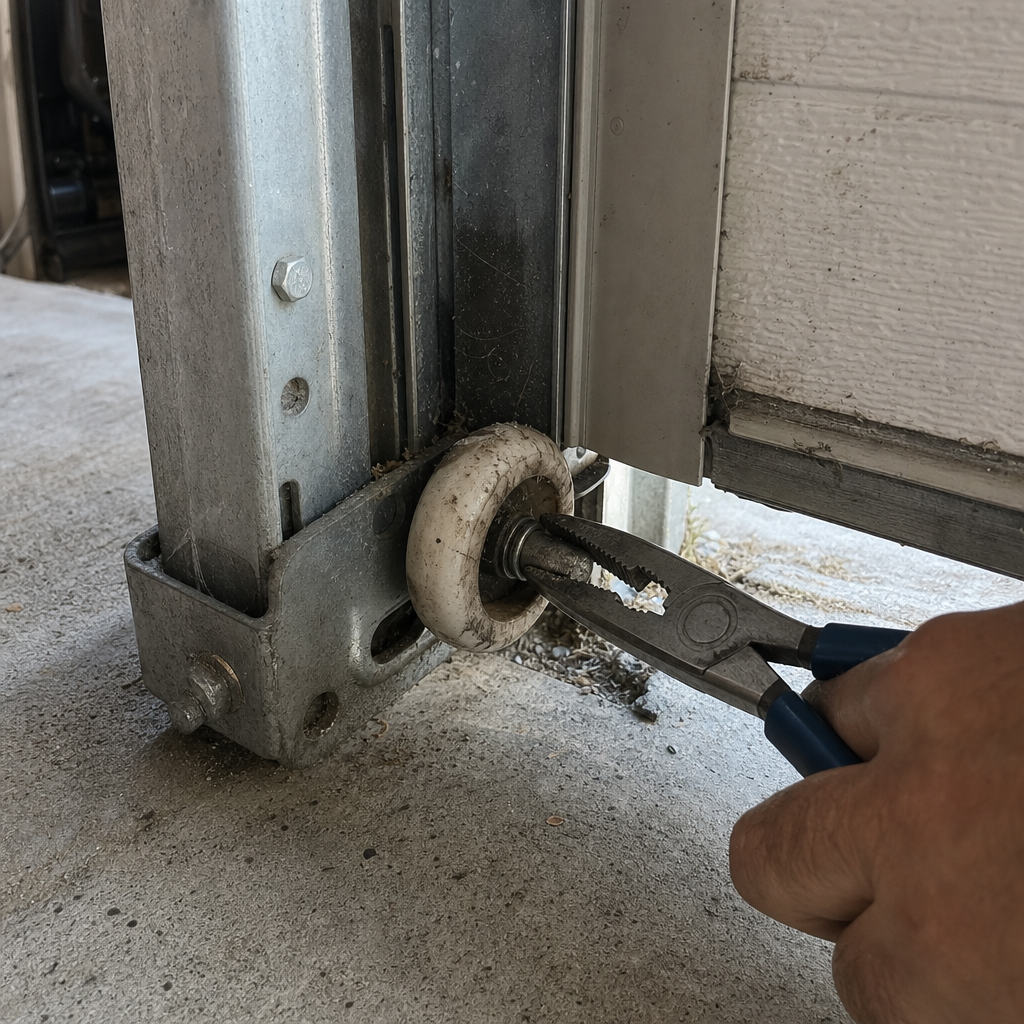
- Check all hardware for corrosion. Look for rust bloom on hinges, rollers, and cable drums. Surface rust on non-structural hardware can be wire-brushed and treated; rust on springs or cables is a replacement signal, not a repair candidate.
- Test the auto-reverse safety feature. Place a 2×4 flat on the ground under the door and trigger the close cycle. The door should reverse on contact. If it doesn’t, the opener’s force settings need adjustment — this is a safety requirement, not optional.
- Inspect the weatherstripping on all four sides. Humid air finding its way into the garage accelerates internal corrosion on everything stored inside, not just the door hardware.
Pre-Dry Season Maintenance (October–November)
- Re-lubricate after the wet season. Six months of rain, humidity, and heat cycles will have worked lubrication out of tight joints. Reapply to springs, hinges, and roller shafts.
- Inspect torsion spring coils for rust. The end of the wet season is when surface corrosion is most visible. Look for reddish-brown discoloration along the coil wire. Compare to the previous year’s inspection photos if you have them.
- Tighten all hardware. Thermal expansion and contraction — even in Miami’s mild temperature range — will vibrate fasteners loose over time. Snug up all lag bolts, track brackets, and hinge screws.
- Test the opener’s battery backup. Hurricane season runs through November 30. Before the risk fully passes, confirm your backup battery is functional so the door operates during a power outage — a realistic scenario after any tropical system.
Choosing the Right Garage Door Opener for South Florida
The opener conversation in Miami has a few South Florida-specific wrinkles that a national buying guide won’t cover.
Battery backup is not a luxury here — it’s essential. Miami loses power during tropical storms, hurricanes, and severe afternoon squalls with enough regularity that an opener without battery backup will leave you stranded in your driveway at the worst possible time. LiftMaster and Chamberlain both offer models with integrated battery backup; this should be a baseline requirement, not an upgrade decision. For Garage Door Opener in Miami Beach properties specifically, where oceanfront storms can knock out power for extended periods, we strongly recommend it.
Belt-drive vs. chain-drive in humid conditions: Belt-drive openers are quieter and perform well in Miami’s climate. Chain-drive units are durable and cost-effective but require more frequent lubrication in humid environments — the chain is a corrosion target if maintenance lapses. Both LiftMaster and Genie make quality options in each drive type; the choice often comes down to budget and noise sensitivity.
Smart openers and surge protection: Wi-Fi-enabled openers from Chamberlain (myQ platform) and Genie allow remote monitoring and control — particularly useful if you have a vacation property or rental unit in Miami. However, South Florida’s frequent lightning storms create surge risk. A dedicated outlet surge protector is a worthwhile $20 addition to any smart opener installation.
Horsepower for heavier NOA-rated doors: Wind-rated doors often run heavier than standard residential doors because of their reinforced construction. A 1/2 HP opener that would handle a standard door easily may struggle with a 16-foot, wind-rated door. We typically recommend 3/4 HP units for double-car doors in Miami-Dade homes.
What to Expect During Garage Door Installation in Miami
A Miami garage door installation isn’t the same process as a standard residential installation in another state — the permit and inspection requirements add steps that a quality contractor handles on your behalf. Here’s the typical sequence:
- Site measurement and code verification. Before any door is ordered, a technician measures the opening, checks the header clearance, and confirms the design pressure requirement for your specific structure. Getting this wrong at the start cascades into permit failures and expensive corrections.
- Door selection and NOA confirmation. The door model is selected with NOA verification as the primary filter. Your installer should provide you with the NOA number for the specific product being installed.
- Permit application. In Miami-Dade County, the contractor pulls the permit. A homeowner relying on an unlicensed contractor who skips this step faces fines and, critically, a home that may not be fully insurable after the fact.
- Old door removal. The existing door, tracks, and hardware are removed and disposed of. Any damage to the rough opening or header framing discovered at this stage needs to be addressed before the new door goes in.
- Installation. New tracks, springs, hardware, and the door panels themselves are installed. For wind-rated doors, horizontal track bracing and anchor bolt specifications must match the NOA documentation exactly.
- Opener installation or reconnection. If a new opener is being installed, it’s mounted and wired at this stage. Safety reversal testing is performed before the job is considered done.
- County inspection. The inspector verifies NOA compliance, anchorage, and hardware. Permit closes upon passing inspection.
Total installation time for a standard residential door is typically three to five hours on-site, not counting the permit and inspection timeline. We handle the full sequence — from Garage Door Installation in Miami Beach properties to inland Doral homes — under one roof, which means no coordination gaps between contractors.
Common Mistakes to Avoid
- Buying a door without verifying the NOA. A nationally popular door with no Miami-Dade Notice of Acceptance cannot be legally permitted here. Verify the NOA number before you pay a deposit — not after the door arrives on a truck.
- Hiring an unlicensed contractor to avoid the permit process. In Miami-Dade County, skipping the permit isn’t a minor technicality. An unpermitted garage door installation can trigger fines, require tear-out and reinstallation, and create complications when you sell the home or file an insurance claim.
- Using WD-40 as a lubricant on springs and hinges. We see this constantly across South Florida. WD-40 displaces water short-term but leaves no protective film and actually attracts particulate matter that accelerates wear. Use a silicone or lithium-based product specifically formulated for garage door hardware.
- Choosing a door based on aesthetics before checking the wind-load requirement for your specific opening. A beautiful carriage-house style door that doesn’t meet your opening’s design pressure is a door you’ll have to replace — at full cost — when the inspector flags it.
- Ignoring spring corrosion because the door still opens. A corroded spring that’s still functioning is a spring approaching sudden failure. In Miami’s coastal environment, surface rust on torsion springs is an early warning that deserves action in the next service visit, not when the spring breaks at 7 a.m. on a Monday.
- Installing a standard opener without battery backup. South Florida’s storm frequency makes power outages a near-annual event for many Miami homeowners. An opener without battery backup turns a manageable inconvenience into an operational problem during exactly the moments when you need reliable access most.
- Skipping the bottom seal replacement to save $30. The bottom seal on a Miami garage door takes a beating from UV exposure, heat, and rain. A failed seal allows water intrusion that damages flooring, promotes mold, and accelerates corrosion on the door’s bottom panels. It’s one of the highest-ROI maintenance items on the list.
When to Call a Professional
Some garage door tasks are legitimate DIY — lubricating hinges, replacing a remote battery, tightening loose screws on a track bracket. Most are not. Call a professional immediately if you encounter any of the following situations:
- A broken torsion or extension spring. These are under several hundred pounds of stored tension; releasing them improperly causes serious injury.
- A frayed or snapped cable. Cables carry the door’s full weight and can whip unpredictably if handled without the right tools.
- A door that’s off its tracks. Forcing it back without understanding why it came off almost always causes additional panel or track damage.
- Any post-storm inspection after a tropical system. Wind-load hardware can sustain non-visible damage that compromises the door’s next storm performance.
- A new door installation requiring a Miami-Dade permit — this needs a licensed contractor by law.
- An opener that reverses unexpectedly, won’t close fully, or shows error codes on the logic board.
Skyline Garage Door Repair North Miami Beach offers free estimates across Miami — call (754) 999-9734 and Robert comes out himself to assess the situation. With 12 years of field experience and 1,200+ five-star reviews behind every visit, you’re getting a diagnosis from someone who has seen the same failure modes dozens of times, not a technician reading off a checklist for the first time.
Frequently Asked Questions
How much does garage door repair cost in Miami?
Most garage door repairs in Miami fall between $120 and $450, depending on the component being replaced. Spring replacement — the most common repair — typically runs $150–$280 for a standard residential torsion spring, including parts and labor. Cable replacement runs $95–$175. Panel replacement costs vary significantly by door model and gauge; expect $200–$600 per panel for a wind-rated steel door. Opener repairs are generally $85–$200 for most common issues. For an exact number on your specific situation, call (754) 999-9734 — estimates are free and there’s no obligation.
How long do garage door springs last in Miami’s climate?
In Miami’s coastal environment, standard torsion springs typically last three to five years — significantly shorter than the seven to nine years manufacturers project for dry-climate conditions. Salt air accelerates corrosion on the coil wire, and elevated humidity year-round compounds the degradation. Upgrading to zinc-coated or oil-tempered springs at replacement time adds measurable lifespan. If your springs are approaching three years old and you notice any surface rust, schedule an inspection rather than waiting for a break.
Do I need a permit to replace a garage door in Miami-Dade County?
Yes. Any garage door replacement in Miami-Dade County requires a building permit, and the replacement door must carry a valid Miami-Dade Notice of Acceptance (NOA). This applies to like-for-like replacements, not just upgrades. The permit ensures the installed door meets the county’s High-Velocity Hurricane Zone wind-load requirements. A licensed contractor pulls the permit on your behalf; a county inspector closes it after installation is verified. Don’t skip this process — an unpermitted door creates liability at resale and during insurance claims.
What’s the best garage door material for a home near the ocean in Miami?
Aluminum is the strongest choice for homes within a mile of the water — it doesn’t rust, carries less weight than steel (reducing stress on springs and openers), and handles salt-air exposure better than any other material at a reasonable price point. For extreme oceanfront exposures, fiberglass is the most corrosion-resistant option but comes at a premium. Heavy-gauge galvanized steel with a quality factory finish is the right answer for most Miami neighborhoods that aren’t directly on the water. Wood and wood-composite should be avoided in high-humidity coastal conditions — they absorb moisture, swell, and deteriorate faster here than anywhere else in the country.
Can a garage door be repaired the same day in Miami?
For most common repairs — broken springs, snapped cables, off-track doors, opener failures — same-day service is realistic when you call before early afternoon. Parts for major brands like LiftMaster, Chamberlain, Genie, Clopay, Amarr, Wayne Dalton, Craftsman, and Raynor are stocked locally, which avoids the one-to-two-day wait that remote or rural areas often face. For emergency situations — a door stuck open overnight, a door that won’t close after a storm — don’t wait until morning. Call (754) 999-9734 and we’ll work to get out to you the same day.
How do I find a reputable garage door company in Miami?
Start with three verifiable signals: a Miami-Dade contractor’s license (which you can verify through the county’s online lookup), a documented review record with volume — not just a handful of testimonials — and a technician who can immediately name the NOA number for the product they’re recommending. Be cautious of bids that skip the permit or can’t specify the door’s wind-load rating. A reputable company will walk you through the NOA, pull the permit themselves, and be on-site for the inspection. Garage Door Repair in Miami Beach and throughout greater Miami follows the same standard — the permit and inspection process is the quality filter, not just a paperwork formality.
The Bottom Line
A garage door in Miami operates in one of the most demanding environments a residential door can face: salt air that corrodes hardware ahead of schedule, hurricane-season winds that require code-specific products, and year-round heat and humidity that accelerate the wear curve on every moving part. The right approach is to start with NOA-verified materials suited for coastal conditions, install with a full permit, maintain on a twice-yearly schedule aligned with the wet and dry seasons, and replace springs and cables proactively rather than reactively. Generic advice written for other climates will steer you wrong here. Build your garage door decisions around what South Florida actually demands — and it’ll perform reliably for decades.
For a free estimate on repair, installation, or any garage door service across Miami, call (754) 999-9734. Robert comes out himself, assesses your specific door and situation, and gives you a straight answer on what it needs — no upsell, no relay through a dispatcher. With 1,245 verified reviews averaging 4.9 stars and 12 years of South Florida experience behind every visit, you’ll know exactly where you stand before any work begins.
Written by Robert Davis, Owner & Lead Technician at Skyline Garage Door Repair North Miami Beach, serving Miami since 2014.