
Last updated June 22, 2026
Seasonal Garage Door Care for Miami: Year-Round Homeowner’s Guide
Most homeowners in Miami treat garage door maintenance the way they treat hurricane shutters — they think about it only when something goes wrong. But here’s what 12 years of field work across Brickell, Wynwood, Coral Gables, and North Miami Beach has taught us: the damage that sidelines a garage door in South Florida almost never happens on the day you notice it. It builds quietly through humidity cycles, salt-air corrosion, and the mechanical stress of two seasons that look nothing like what garage door guides written for Chicago or Denver describe. This guide is built specifically for Miami homeowners who want to stay ahead of that damage — before it becomes a Tuesday-morning emergency.
Quick Answer
Seasonal garage door care in Miami centers on two threats that don’t get enough attention in generic maintenance guides: moisture intrusion from the wet season (June–October) and hardware stress during the dry season (November–April), which is counterintuitively when springs and seals are most likely to fail. The year-round maintenance routine for a Miami home breaks into four phases — pre-hurricane prep, wet-season protection, dry-season re-lubrication, and a single annual professional calibration — and following all four adds measurable years to your door’s service life.
Table of Contents
- Why Miami’s Dry Season Is When Springs Snap
- Pre-Hurricane Season Tasks (April–May)
- Wet Season Management (June–October)
- Dry Season Maintenance Tasks (November–April)
- How to Assess Post-Storm Damage Yourself
- The One Annual Task Worth Paying a Professional For
- Common Mistakes to Avoid
- When to Call a Professional
- Frequently Asked Questions
- The Bottom Line
Why Miami’s Dry Season Is When Springs Snap
This is the counterintuitive truth we find ourselves explaining to homeowners in Pinecrest and South Miami every January: garage door springs fail more often in the dry season than during the wet, humid months everyone assumes are harder on hardware. Here’s the mechanics behind it.
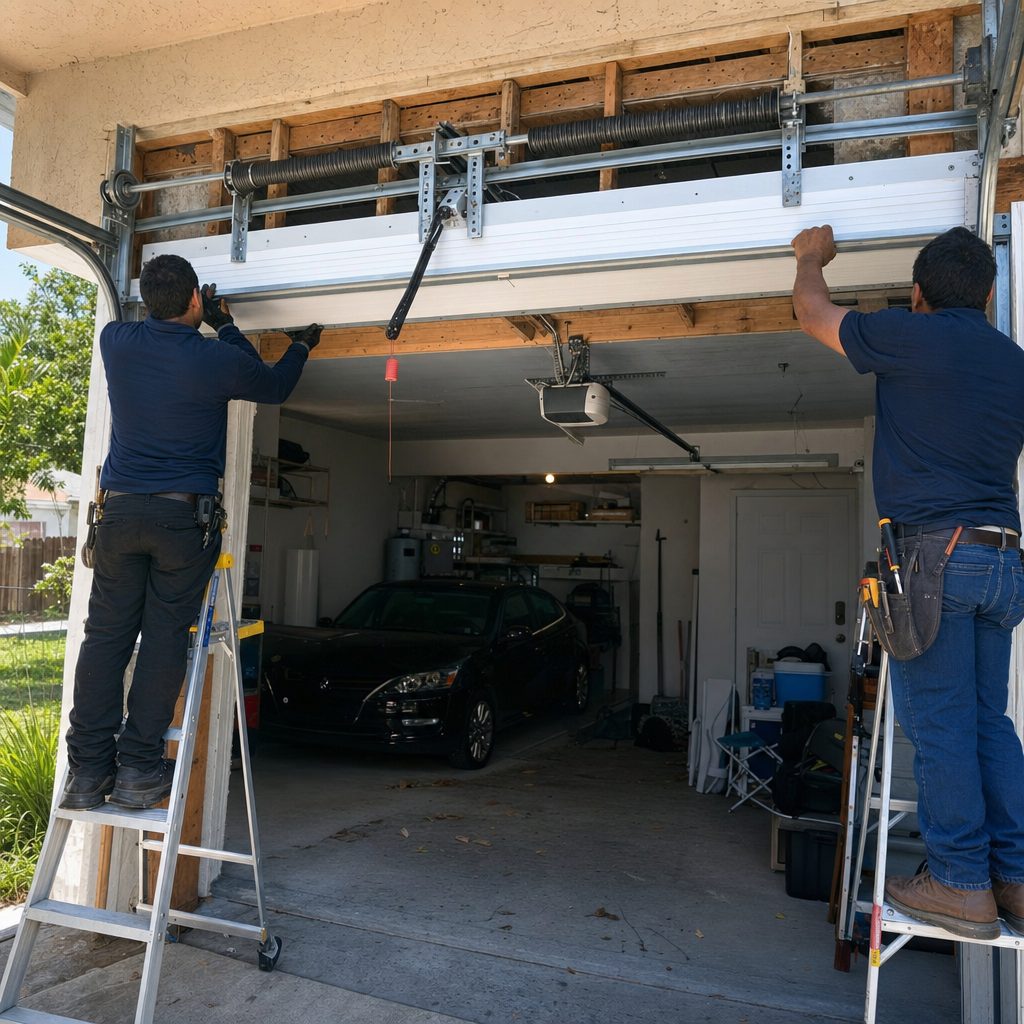
Torsion springs — the horizontal coils mounted above your garage door — are calibrated to a specific tension range. Through Miami’s summer, high ambient humidity causes the metal to expand slightly and keeps residual lubricant in place. When the dry season arrives and relative humidity drops, the metal contracts, lubricant thins out from reduced molecular viscosity, and a spring that’s already logged several thousand cycles starts operating outside its comfort zone. Add a cool front — Miami does get those brief 55–60°F nights between December and February — and a fatigued spring can snap under a load it handled just fine six months ago.
The failure pattern we see most in Miami’s winter months follows a predictable script: the spring has been working since the previous dry season with no re-lubrication, the summer humidity masked the wear, and by January or February the coil finally gives out. The door either won’t open at all or opens a few inches and stalls, leaving a car trapped inside or the garage exposed.
Understanding this cycle is the foundation of a Miami-appropriate maintenance calendar. Everything else in this guide flows from knowing that the threats here are moisture and dry-cycle contraction — not ice, not freeze-thaw, not any of the northern hazards most generic guides are written around.
Pre-Hurricane Season Tasks (April–May)
Atlantic hurricane season officially opens June 1, but the preparatory window that actually matters runs through April and May — before the first named storm forms and before contractors are swamped with last-minute calls. In Miami, a garage door isn’t just a convenience; it’s a wind barrier that, if it fails during a storm, can allow pressure equalization inside the structure and contribute to roof loss. That’s not alarmism — it’s why Miami-Dade County has some of the most specific wind-load requirements for garage doors in the country.
Wind-Load Verification
Confirm your door is rated for the wind speed required by your local jurisdiction. Miami-Dade doors installed after the post-Andrew code reforms should carry a product approval number. If your door predates 2002 or was installed by a previous owner, locate the product sticker on the door section or the end stile and verify it against the Florida Product Approval database at floridabuilding.org. Doors from brands like Clopay, Amarr, and Wayne Dalton that carry Miami-Dade NOA (Notice of Acceptance) are built and tested to specific design pressures — if yours doesn’t have that designation, that’s a conversation worth having before June.
Horizontal Brace Inspection
Sectional doors rely on horizontal bracing struts across the back of each panel to resist wind load without buckling. Check every strut for corrosion, bending, or loose fasteners. A strut that looks intact but has surface rust eating through the steel web has lost a meaningful percentage of its rated strength. In salt-air neighborhoods like Miami Beach or Key Biscayne, brace corrosion moves faster than inland — check annually, not every five years.
Battery Backup Testing
LiftMaster and Chamberlain openers with battery backup are standard on many Miami homes, and for good reason: power outages during storms are measured in days, not hours. Test the battery backup by unplugging the opener’s power cord and running the door three to four full cycles. If the door slows significantly or the backup warning light flashes, replace the battery before the season starts. Battery replacement costs roughly $30–$60 for most LiftMaster and Chamberlain units and is a five-minute job.
Pre-Hurricane Checklist
- Verify door carries a valid Miami-Dade NOA or equivalent wind-load rating.
- Inspect all horizontal bracing struts for rust, deformation, or loose hardware.
- Test battery backup through 3–4 full cycles with power disconnected.
- Check bottom seal for gaps — a compromised seal lets wind pressure build under the door.
- Confirm manual release cord is accessible and functional for post-storm exit if power fails.
- Photograph the door’s condition now — useful for insurance purposes if storm damage occurs later.
Wet Season Management (June–October)
From June through October, Miami trades dry air for daily afternoon downpours, sustained high humidity, and standing water that can sit against a garage threshold for hours after a storm. For garage doors, this translates to three concurrent threats: seal failure, accelerated corrosion, and opener electrical exposure.
Seal Integrity
The bottom seal — the rubber or vinyl strip pressed against the floor when the door closes — is your first line of defense against water intrusion. Miami’s wet season will expose every gap in a failing seal quickly. Run a flashlight along the closed door threshold from inside: any visible light means water will enter. Replace worn bottom seals before June if possible; PVC-backed seals hold up better than pure rubber in South Florida heat. Threshold seals (glued to the floor rather than the door) add a second layer and are worth installing if your garage floor sits at or below driveway grade — a common situation in older Hialeah and Little Havana homes.
Corrosion Acceleration
Standing water against a steel door’s bottom section or hardware can pit raw metal in a single season in Miami’s climate. Inspect hinges, roller brackets, and the bottom fixture plates after heavy rain events for surface rust. A light wipe with a dry cloth followed by a thin application of white lithium grease on metal-to-metal contact points interrupts the corrosion cycle without attracting excessive dirt. Stainless-steel hardware — available on higher-end Clopay and Amarr lines — is worth specifying on a replacement door if your current hardware corrodes repeatedly.
Opener Electrical Protection
Genie, Craftsman, and Raynor openers share a vulnerability with every brand: the logic board and motor capacitor are sensitive to voltage fluctuations and power surges during storms. A plug-in surge protector rated for garage door openers costs under $20 and absorbs the voltage spike that a near-miss lightning strike sends through the line. If you lose an opener to a surge without one in place, the repair bill is typically $150–$300 for the logic board alone — and that’s assuming the motor survives too.
Dry Season Maintenance Tasks (November–April)
The dry season is the right time to reset your door’s mechanical condition after six months of humid-air exposure. Think of it as the post-summer tune-up window — humidity drops, temperatures moderate, and the hardware is accessible for inspection without the afternoon downpour interrupting the job.
Re-Lubrication Schedule
Apply a silicone- or lithium-based spray lubricant (not WD-40, which is a solvent that strips existing grease rather than adding it) to the following points: torsion spring coils, hinges at every panel junction, roller stems, the two bearing plates at each end of the spring shaft, and the track’s curved sections only — never the flat vertical tracks, which need traction, not lubrication. In Miami’s climate, once per year at the start of the dry season is the practical minimum; doors on homes near the water in Miami Beach or Aventura benefit from a mid-season touch-up in February.
Spring Tension Check
You can do a basic functional check without touching the spring hardware: disconnect the opener, lift the door manually to waist height, and let go. A properly balanced door stays put or drifts closed no more than a few inches. A door that crashes down or flies upward has a tension problem. Do not attempt to adjust torsion spring tension yourself — the stored energy in a fully wound spring is enough to cause serious injury, and this task belongs to a trained technician.
Weatherstripping Replacement
The side and top weatherstripping — the flexible vinyl or rubber seal around the door’s perimeter — contracts in drier, cooler air and can pull away from the frame or develop cracks. Inspect it in November before the dry cycle is fully established. Replacement stripping sold by the foot at any home improvement store in Miami runs $0.50–$1.50 per linear foot installed yourself, or around $80–$150 for a professional to replace the full perimeter on a standard two-car door.
Dry Season Task List
- Lubricate spring coils, hinges, roller stems, and bearing plates with white lithium or silicone spray.
- Check door balance by hand — should hold position at waist height.
- Inspect and replace cracked or separated weatherstripping on all four sides.
- Test auto-reverse safety function: place a 2×4 flat on the floor under the door and close it — it should reverse on contact.
- Tighten any loose hardware on the tracks, hinges, and opener mounting brackets.
- Clean dirt and debris from photo-eye sensors with a dry cloth.
How to Assess Post-Storm Damage Yourself
After a named storm or a particularly intense squall line moves through Miami, a visual assessment of your garage door can tell you whether you’re dealing with cosmetic damage you can log and move on from, or a structural or mechanical issue that makes the door unsafe to operate until a technician arrives.
What to Look For — Step by Step
- Don’t operate the door yet. Before touching the opener remote or wall button, walk up to the door from outside and look at its overall plane. A door that’s visibly bowed, buckled, or has a panel that’s pushed inward has likely sustained wind-load damage. Operating it can worsen panel stress and potentially snap a cable or damage the tracks.
- Check the tracks for bending or separation. Look at both vertical tracks where they anchor to the wall and where they transition to the horizontal run. A bent track will cause the rollers to bind or derail the door mid-travel.
- Inspect the bottom section and threshold. Water intrusion itself doesn’t prevent safe operation, but debris packed into the track channel will. Clear visible debris before attempting to run the door.
- Look at the torsion spring and cables. If a spring is visibly separated into two pieces or a cable has unwound from its drum, do not try to operate the door. These are safety failures, not cosmetic ones.
- Test balance manually first. If the door looks undamaged, disconnect the opener and try lifting it by hand before engaging the motor. A door that feels significantly heavier than normal or won’t move freely indicates a mechanical problem.
- Cosmetic damage to note for insurance. Dents, paint damage, and cracked panels that don’t affect the door’s structural function are cosmetic. Photograph them immediately, note the date, and document them for your homeowner’s insurance claim — Miami insurers require timely notification of storm damage.
Cosmetic vs. Safety Failure — Quick Reference
- Cosmetic (safe to operate, document and repair when convenient): Surface dents in panels, scratched finish, minor bottom-seal tearing, loose trim.
- Safety failure (do not operate — call a technician): Broken or separated torsion spring, detached or frayed cables, bent or derailed track, buckled panel section, door sitting visibly off-plumb.
The One Annual Task Worth Paying a Professional For
If you DIY every other item on this list — the lubrication, the seal replacement, the battery backup test — there’s still one task we’d recommend paying a trained technician to handle every year: torsion spring tension calibration.
Here’s why it earns that distinction. A torsion spring stores enough mechanical energy when fully wound to cause serious injury if it releases unexpectedly during adjustment. The work requires reading the door’s exact weight (which varies by panel material, insulation, and hardware), calculating the correct number of turns for the spring diameter and wire gauge, and making those adjustments with the right winding bars and the correct body positioning. It’s not complicated for someone trained to do it — but the consequences of a mistake are not forgiving.
Beyond safety, proper spring calibration directly extends the spring’s service life. A spring that’s over-wound to compensate for an unbalanced door cycles through more stress per operation than it was rated for. In Miami’s climate, where the spring is already dealing with humidity-driven corrosion and dry-cycle contraction, keeping the tension correct is one of the most effective ways to avoid a mid-season failure.
The cost of a professional spring balance and calibration check in Miami typically runs $75–$150 depending on the number of springs and whether any adjustment parts are needed. That’s a reasonable annual investment against a spring replacement cost of $180–$320 per spring, not counting the inconvenience of a door that fails at 7 a.m. on a workday.
In our experience at Skyline Garage Door Repair, the homes that go longest between spring replacements are the ones where calibration has been kept current — and Miami’s climate accelerates the wear cycle enough that skipping it shows up in the service record faster than it would in a drier region.
Common Mistakes to Avoid
- Using WD-40 on torsion springs and hinges. WD-40 is a water displacer and light solvent, not a long-term lubricant. It strips existing grease from contact surfaces and leaves hardware more vulnerable to corrosion — a significant problem in Miami’s salt-air environment. Use white lithium grease or a silicone-based spray formulated for garage door hardware.
- Skipping pre-hurricane prep because last year was quiet. Miami homeowners are statistically prone to complacency after an uneventful season. Wind-load compliance and brace integrity need to be checked annually regardless of prior-year storm activity — the door’s condition doesn’t reset because storms missed you.
- Installing a non-rated door in a Miami-Dade jurisdiction. Doors without a valid Miami-Dade Notice of Acceptance or equivalent Florida Product Approval are not code-compliant for new installation in Miami. Using a non-rated door to save money on a replacement exposes you to failed inspection, insurance complications, and structural risk in a wind event.
- Operating a door with a broken torsion spring. A door with one broken spring in a two-spring system still functions — but it’s running on one spring doing the work of two, which accelerates cable wear and risks cable failure. Homeowners in Doral and Kendall sometimes operate in this condition for weeks without realizing it. Get it addressed promptly.
- Ignoring water intrusion because it “dries out.” Standing water that enters under a door in Miami’s wet season evaporates — but it leaves mineral deposits, promotes mold growth in garage insulation, and accelerates corrosion on bottom hardware. Address seal failures before the wet season starts, not after the damage is visible.
- Replacing only one spring when both are the same age. On a two-spring system, both springs are typically installed at the same time and undergo the same wear cycle. If one breaks, the other is at statistically equal risk. Replacing both at the same service call costs marginally more and avoids a second call-out fee within months.
- Overlooking opener surge protection near the coast. Miami Beach, Sunny Isles, and Aventura homeowners are in areas with elevated lightning activity and frequent power fluctuations during storm season. Running an opener without surge protection is a common omission that leads to avoidable logic board failures.
When to Call a Professional
DIY maintenance covers a lot of ground — lubrication, seal replacement, sensor cleaning, basic hardware tightening. But certain situations in Miami genuinely require a technician on-site, and trying to push past them is where routine maintenance turns into a larger repair bill.
Call a professional if you see any of these: a torsion spring that’s visibly broken or separated; a cable that’s frayed, slack, or unwound from the drum; a track that’s bent enough to bind the rollers; a door that won’t hold balance when disconnected from the opener; or an opener that runs but the door doesn’t move (which usually means the disconnect engaged or a drive component failed). Post-storm, call before operating any door that shows structural deformation, even if it appears to move freely.
For annual spring calibration, don’t wait for a symptom — schedule it proactively as part of your pre-hurricane prep window in April or May.
Skyline Garage Door Repair North Miami Beach offers free estimates on all service calls in Miami — call (754) 999-9734 and Robert will give you a straight answer on what the job actually needs.
Frequently Asked Questions
How often should I lubricate my garage door in Miami?
Lubricate your garage door hardware once at the start of the dry season (November) and again in February if you live near the coast in areas like Miami Beach, Aventura, or Surfside where salt air accelerates wear. Use white lithium grease or silicone spray on the spring coils, hinges, roller stems, and bearing plates — not WD-40. Doors that see daily use benefit from more frequent attention; high-cycle commercial doors may need quarterly service. For a free assessment of your specific door’s lubrication needs, call (754) 999-9734.
Does my garage door need to be hurricane-rated in Miami?
Yes, if you’re installing or replacing a door in Miami-Dade County, it must carry a valid Florida Product Approval or Miami-Dade Notice of Acceptance confirming it meets the applicable wind-load design pressure for your location. Existing doors installed under prior code are not automatically required to be replaced, but they should be inspected for horizontal brace integrity before each hurricane season. Brands like Clopay, Amarr, and Wayne Dalton manufacture lines specifically engineered to meet Miami-Dade standards — if you’re due for a replacement, that’s the direction to go. Call (754) 999-9734 for guidance on what your current door is rated for.
Why did my garage door spring break in January — isn’t summer harder on the hardware?
Spring failures in Miami actually peak in the dry season, not the wet. Low winter humidity causes metal to contract and existing lubricant to thin out, putting additional stress on springs that may have been quietly fatiguing through the summer’s humidity cycles. A brief cold front — Miami’s 55–60°F nights in December and January — can push a worn spring past its tolerance. The fix is annual lubrication and a professional tension calibration in the fall before the dry cycle starts. If your spring just broke, call (754) 999-9734 for same-day service.
What should I check on my garage door after a hurricane or tropical storm?
Before operating the door, visually inspect the panel faces for buckling, check both tracks for bending or separation from the wall, and look at the torsion spring and cables for any visible break or detachment. If anything looks structurally compromised, don’t operate the door — call a technician first. Cosmetic dents and surface damage are fine to document and operate through, but a bent track or broken spring makes the door unsafe to run until repaired. Photograph all damage promptly for insurance documentation. Call (754) 999-9734 if you need a post-storm assessment.
How much does garage door spring replacement cost in Miami?
Spring replacement in Miami typically runs $180–$320 per spring, depending on spring size, wire gauge, and whether you’re replacing one or both springs on a two-spring system. On a two-spring door where one spring has broken, replacing both at the same service call is the practical choice — the second spring is at comparable fatigue and the labor overlap makes it significantly more cost-effective than two separate visits. Annual calibration service to prevent failure runs $75–$150. Call (754) 999-9734 for an exact quote on your specific door — estimates are free.
Can I use my garage door opener if the power is out after a storm in Miami?
Yes, if your opener has a battery backup unit installed — LiftMaster and Chamberlain both offer models with integrated backup batteries that power the door through multiple open-close cycles during an outage. If your opener doesn’t have a battery backup, you can still operate the door manually by pulling the red emergency release cord, which disconnects the carriage from the drive and lets you lift the door by hand. Test both the backup battery and the manual release before hurricane season so you’re not working through it for the first time after a storm. For Garage Door Opener in Miami Beach service and battery backup installation, call (754) 999-9734.
The Bottom Line
Miami’s garage door maintenance calendar doesn’t look like what the national guides describe — and following advice written for northern climates will leave you underprepared for the two things that actually shorten a door’s life here: wet-season moisture intrusion and dry-season hardware stress. The homeowners who avoid emergency calls are the ones who run through pre-hurricane checks every April, keep seals current before the rains arrive in June, lubricate hardware when the dry season starts in November, and schedule a professional spring calibration once a year. Everything else on this list you can handle yourself. That one task — spring tension calibration — is worth paying a technician for, every time, no exceptions. Get those four things right and your door will outlast the ones on either side of yours.
If you’re due for a tune-up, need post-storm damage assessed, or want to know whether your current door is properly rated for Miami’s wind requirements, Garage Door Repair in Miami Beach and throughout the Miami area is what we do every day. Whether you’re considering a new installation — explore Garage Door Installation in Miami Beach for options — or just need a spring replaced before it fails, Robert comes out himself, every job. Call (754) 999-9734 for a free estimate. No dispatcher, no rotating crew — you get the owner on-site and the answer the same day.
Written by Robert Davis, Owner & Lead Technician at Skyline Garage Door Repair North Miami Beach, serving Miami since 2014.